“Vibe coding” has become a hot topic. But what is the risk for a seasoned software developer?
The questions I can’t answer on my own
I have been developing software solutions for many years, and lately—like everyone else—I find myself asking existential questions about my professional future:
- Will I still have a job next year?
- Do my work and skills still hold value?
- Etc.
No one can give a definitive answer, but I decided to ask the online community for their take on this.
What I put in front of them
A few weeks ago, I posted the landing page for a project currently in development on Reddit; it was just a concept at the time, though it had taken months of work to refine.
I won’t go into the details of the project here, but it was highly technical in nature, making it a prime target for criticism and observations regarding architectural choices that were admittedly open to debate.
The criticism went after the method, not the product
The result? The vast majority of comments criticized the method rather than the product or the value proposition itself.
“Vibe-coding”
“Junk”
“It sucks”
In short, there was no constructive criticism. People even accused the post itself of being written by AI—which wasn’t the case.
The assumption that everything is machine-made
There is a strong bias at play here, leading everyone to assume that everything produced these days is created entirely by AI, which simply isn’t true.
The real damage lies in the misleading message being spread: that AI is synonymous with “vibe coding.” That is a massive falsehood.
AI-assisted coding is a different method
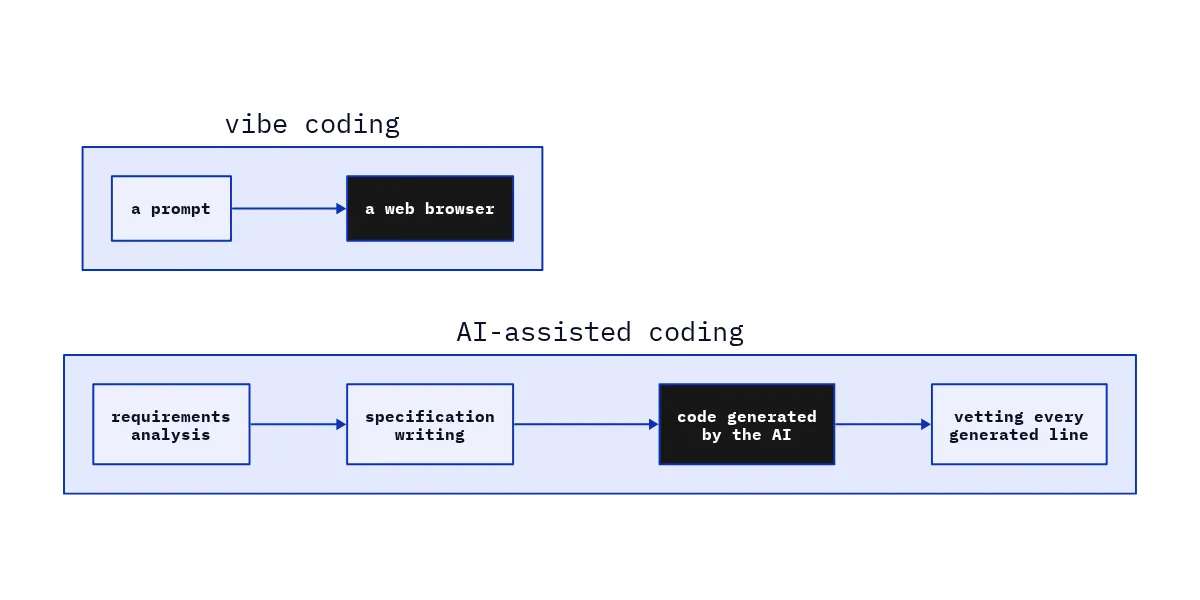
AI-assisted coding is a completely different method from “vibe coding.” It requires weeks of work on requirements analysis, specification writing, and vetting all the code generated by the AI—tasks that balance out the time saved during the actual coding phase.
Then there are those who reject AI entirely for political or ethical reasons, but that is a whole other topic.
The danger isn’t the loss of value
Ultimately, I don’t believe the danger to our profession lies in a loss of value. If we have experience, we remain architects whose skills are still valuable. The problem lies in the message that is being conveyed.